
Introduction
In the automotive refinishing and OEM manufacturing sectors, surface preparation consumes a significant share of total bodyshop labor hours. While pressure sensitive adhesive masking tapeaccounts for a minimal portion of overall consumable expenditures in a paint shop, its quality directly impacts the final finish. Paint bleeding along complex vehicle contours, adhesive degradation during thermal bake cycles, and backing tearing during peeling lead to costly rework, customer complaints, and extended cycle times.
Achieving clean paint lines and residue-free removal requires a comprehensive technical understanding of backing elasticity, adhesive chemistry, and thermal limits. Over 15 years of deep experience in global adhesive tape manufacturing and export, evaluating paint line failures across tier-1 automotive suppliers, bodyshops, and industrial coating facilities has highlighted the critical need for precise material selection. Working closely with leading masking tape companies and international procurement managers reveals that selecting the right grade is both a quality requirement and an economic necessity.
This technical guide provides procurement managers, engineers, and importers with an objective analysis of automotive crepe paper masking tape parameters, adhesive selection frameworks, quality control benchmarks, and procurement practices for high-efficiency painting environments.
1. Industry Pain Points in Automotive Paint Masking
Automotive paint refinishing involves intense thermal stresses, aggressive solvent exposures, and complex three-dimensional surface profiles. Standard commercial masking products or low-grade sticky masking tape frequently encounter severe operational challenges under these demanding conditions.
Key Technical Failure Mechanisms
- Paint Bleeding and Edge Seepage: Low-grade paper carriers lack micro-conformability. When applied around vehicle contours or curved lines, the tape can lift at the edges, allowing low-viscosity primers, basecoats, and clearcoats to seep under the boundary. This results in jagged edges that demand hours of manual color sanding and polishing.
- Adhesive Residue and Cohesive Breakage: When exposed to high-temperature bake cycles inside paint booths, inferior adhesive formulations degrade. The polymer bonds break down, causing cohesive failure where the adhesive mass detaches from the crepe backing and remains firmly stuck to the vehicle clearcoat or glass trim.
- Backing Slivering and Tearing: During rapid peeling after oven curing, low-tensile paper backings may tear into thin slivers rather than releasing in a continuous strip. Technicians are forced to scrape off small remnants manually, risking permanent scratches on fresh paintwork.
- Chemical Staining and Ghosting: Solvents in high-solids basecoats and clearcoats can migrate through non-barrier backings if the saturation layer is thin or uneven, reacting with the underlying finish to leave permanent ghosting marks or discoloration.
2. Technical Selection Standards for B2B Buyers
Evaluating masking tape industrial applications requires analyzing key physical metrics rather than relying on basic visual checks. When sourcing from established masking tape companies, technical procurement teams should systematically verify core properties based on verified product specifications:
- Temperature Resistance Capabilities: Automotive refinishing and industrial painting environments require specific thermal ratings. Options range from 60 °C and 80 °C for standard air-dry or low-bake shops, 100 °C and 120 °C for medium bake ovens, up to 150 °C and 200 °C heat proof masking tape and thermal masking tape variants designed for extreme high-temperature industrial bake cycles.
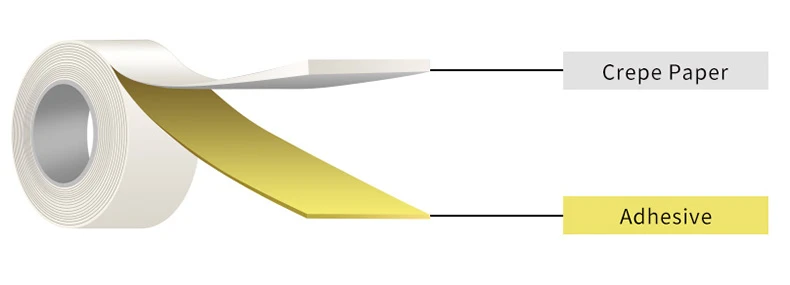
- Carrier Substrate Construction: Industrial grade products are constructed with specialized crepe paper designed for hand tearability, high conformability, and convenience for writing batch codes or measurements directly on the backing.
- Adhesive Chemistry Systems: Professional lines utilize either natural rubber adhesive or acrylic adhesive systems, offering low, middle, or high adhesion levels tailored to specific surface energy substrates.
- UV Weatherability: Depending on job site conditions, products must provide 14 to 60 days of UV resistance for both indoor and outdoor finish painting without baking onto window glass or trim.
3. Comprehensive Product Specification Matrix
Below is the verified technical parameter matrix for the Naikos NKS-###CMT masking tape series based directly on laboratory and factory product specifications:
| Technical Parameter / Property | NKS-###CMT Series Specifications |
| Available Color Spectrum | White, Yellow, Blue, Green, Red, Orange, Pink, Black etc. |
| Carrier Substrate | Crepe Paper |
| Adhesive Chemistry System | Rubber Adhesive / Acrylic Adhesive |
| Adhesion Level Categories | Low / Middle / High |
| Temperature Resistance Spectrum | 60 °C / 80 °C / 100 °C / 120 °C / 150 °C / 200 °C |
| Standard & Custom Width Range | 1.5 ~ 1250 mm (0.06 ~ 49 inch) (Customized Width Available) |
| Standard & Custom Length Range | 1 ~ 1800 m (Customized Length Available) |
4. Key Product Features and Application Scenarios
Core Features
- 14-60 Days UV Resistance: Engineered to withstand prolonged solar UV exposure without adhesive baking or backing degradation.
- Quick Stick: High initial tack provides instant bonding to auto body panels, rubber seals, and glass surfaces.
- Easy Tear by Hand: Crisp crosswise tearability eliminates the need for cutting tools during fast-paced body shop operations.
- Convenient for Writing: Saturated paper surface accepts ink and markers easily for labeling and identification.
- Easy to Peel Without Residual Glue: Specially formulated pressure sensitive adhesive masking tape releases cleanly in a single strip without leaving sticky residue behind.
Primary Industrial Applications
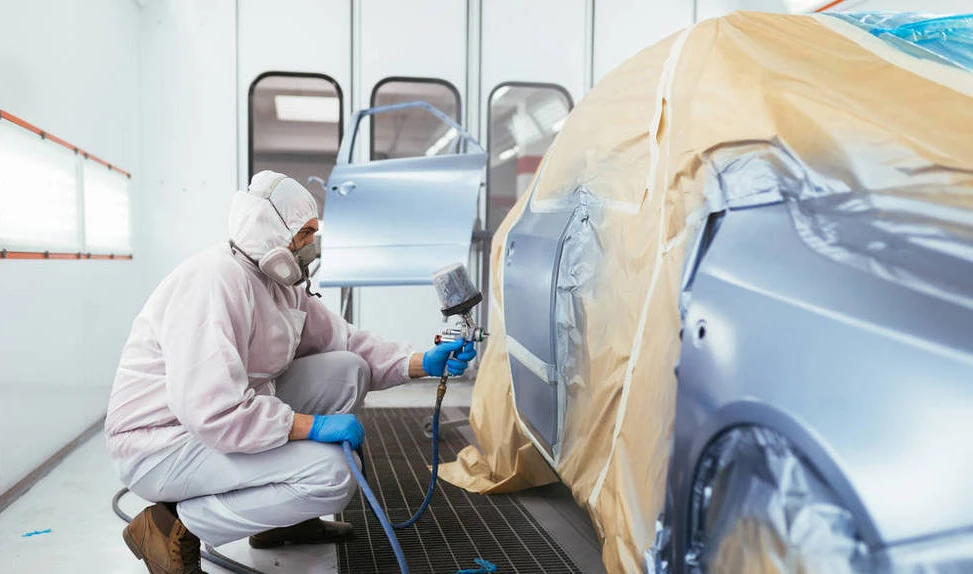
- Protection of Unpainted Areas: Safeguards surrounding panels, headlights, plastic trims, and glass during spraying operations.
- Indoor and Outdoor Finish Painting: Delivers sharp color separation lines for residential, commercial, and industrial painting projects.
- Wrapping Light Weight Objects: Securely holds masking paper, plastic sheeting, and protective films in place.
- Multi-Industry Versatility: Ideal for building, furniture, and auto contexts-including car painting, industrial paint operations, metope paint, paper fixing, wall painting, and interior decoration.
5. Quality Control Benchmarks and Common Sourcing Pitfalls
In global tape procurement, unit price variations often mask critical quality differences. B2B buyers must watch for these common manufacturing shortcuts:
1. Shallow Paper Saturation vs. Deep Impregnation
Low-cost crepe paper tape often uses light surface spraying rather than deep saturation. When waterborne paints or high-solvents hit shallow-saturated paper, moisture penetrates the backing, causing it to soften, wrinkle, and tear into small fragments during removal.
2. Dust-Generating Crush Slitting
Inferior log slitting processes use dull blades that produce paper dust along the roll edges. This dust mixes with the adhesive line, forming micro-gaps when applied to a car body. Paint seeps through these dusty gaps, destroying crisp paint lines.
6. Application Best Practices for Paint Shops
To achieve optimal performance with pressure sensitive adhesive masking tape, bodyshops should follow standardized application procedures:
- Surface Cleaning: Clean body panels with a 50:50 Isopropyl Alcohol (IPA) and water mixture to remove oils, polish, and sanding dust before tape application.
- Firm Application Pressure: Apply firm thumb or roller pressure ($10 - 15\text{ psi}$) to activate the pressure-sensitive adhesive and achieve full surface contact.
- Controlled Stretch around Curves: When masking tight curves, avoid over-stretching the paper backing. Over-stretching creates tension that pulls the tape away from the panel inside a warm bake booth.
- Oven Cool-Down Protocol: Allow the vehicle body to cool down below 40 °C after oven baking before peeling. Removing rubber-based tape while the clearcoat and adhesive are still hot increases the risk of adhesive transfer.
- 45-Degree Angle Removal: Pull the tape backward flat against itself at a 45-degree angle to the paint line for a razor-sharp, clean finish.
7. B2B Procurement and Custom Converting Strategies
For regional distributors, importers, and large automotive plants, optimizing tape procurement requires balancing format options and custom specifications:
Jumbo Log Rolls vs. Finished Cut Rolls: Regional converters with slitting equipment benefit from ordering jumbo master logs to cut custom widths locally. Distributors can order pre-slit finished rolls in popular retail or wholesale pack configurations.
Thermal Matching: Match the temperature rating (60 °C up to 200 °C) directly to your target buyers' paint booth capabilities to avoid over-specifying or under-specifying.
Private Label OEM Branding: Utilize custom-printed inner cores, customized shrink packaging, and private label carton printing to build brand equity in local markets.
8. Frequently Asked Questions (FAQ)
Q1: What makes Naikos crepe paper masking tape suitable for automotive and industrial paint masking?
A: Naikos crepe paper masking tape combines quick stick initial tack, easy hand tearability, and clean removal without residual glue. Its temperature resistance spectrum from 60 °C up to 200 °C ensures reliable performance across air-dry, medium-bake, and high-heat industrial paint environments.
Q2: How do I choose between rubber adhesive and acrylic adhesive systems for masking tape industrial applications?
A: Rubber adhesive systems offer high initial tack and quick stick properties on various surface energies, making them ideal for standard automotive refinishing and masking paper attachment. Acrylic adhesive systems provide exceptional UV weatherability and long-term age resistance, making them well-suited for extended outdoor finish painting lasting 14 to 60 days.
Q3: What thermal resistance ratings are available in the NKS-###CMT masking tape series?
A: The series offers versatile temperature resistance steps including 60 °C, 80 °C, 100 °C, 120 °C, 150 °C, and 200 °C heat proof masking tape options to handle everything from standard touch-ups to high-bake thermal masking tape operations.
Q4: Can I order customized widths and lengths for automated dispensing or specific shop needs?
A: Yes. Widths can be slit from 1.5 mm up to 1250 mm (0.06 to 49 inches), and roll lengths range from 1 meter up to 1800 meters for jumbo log or spool formats. Customized widths and lengths are fully available upon request.
Q5: Is this tape suitable for outdoor painting and multi-surface applications?
A: Yes. It features 14 to 60 days of UV resistance and is designed for indoor and outdoor finish painting, building, furniture, auto applications, wall painting, paper fixing, and general surface protection.
As a trusted manufacturer and exporter among international masking tape companies, Naikos delivers factory-direct pressure sensitive adhesive masking tape solutions to importers, automotive suppliers, and industrial distributors worldwide.