


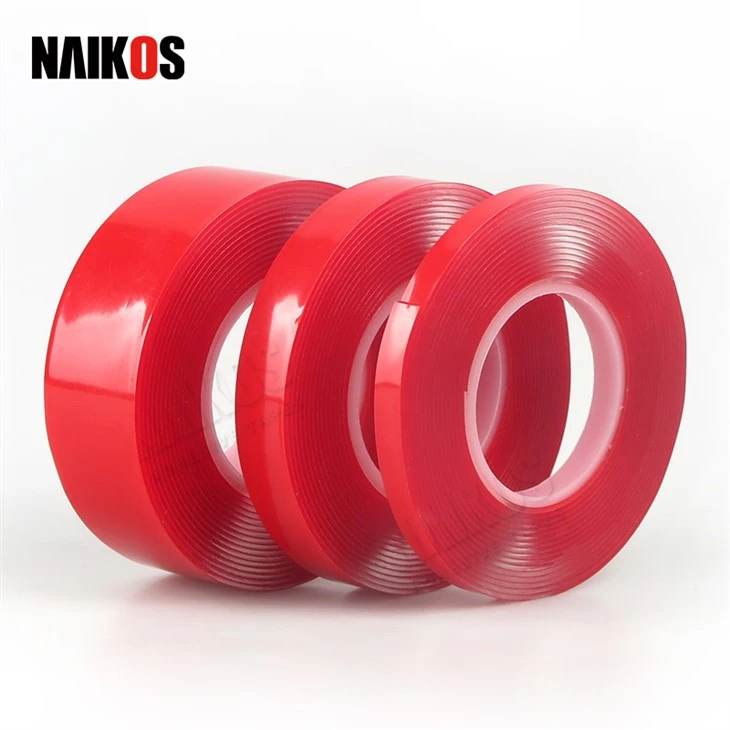


Products Description
When selecting an acrylic foam tape for industrial use, engineers usually look beyond the advertised adhesion value and focus on how the material behaves after assembly. Load direction, environmental changes, component movement and assembly conditions all affect how an adhesive material performs after installation.
Heavy duty double sided acrylic foam tape is developed for applications where stable attachment, controlled bonding thickness and long-term holding performance are required. The tape uses an acrylic foam structure with double-sided pressure sensitive adhesive layers to provide a reliable connection between different components.
During operation, the viscoelastic foam layer helps the adhesive system respond to mechanical movement and temperature changes. This makes the tape suitable for assemblies involving metal, painted surfaces, glass, ABS, PC and other engineering materials.
This acrylic foam adhesive tape is available in different thickness levels for applications requiring various bonding distances, load requirements and installation conditions.
Products Construction

Technical Specifications
| Property | Value |
| Available Colors | Transparent / Gray / White / Black |
| Backing Material | Acrylic Foam |
| Adhesive Type | Acrylic Pressure-Sensitive Adhesive |
| Thickness Range | 0.25 - 3.0 mm (10 - 120 mil) |
| 90° Peeling Resistance | ≥ 34 N/cm (20 lbs/in) |
| Holding Power (7 days @ 22°C / 72°F) | 1,500 g |
| Operating Temperature Range | -40°C to 150°C (-40°F to +302°F) |
| Roll Width |
5 - 610/900 mm (0.2 - 24/35 in) (Custom widths upon request) |
| Standard Length |
33 m (36 yds) (Custom lengths upon request) |
Key Features
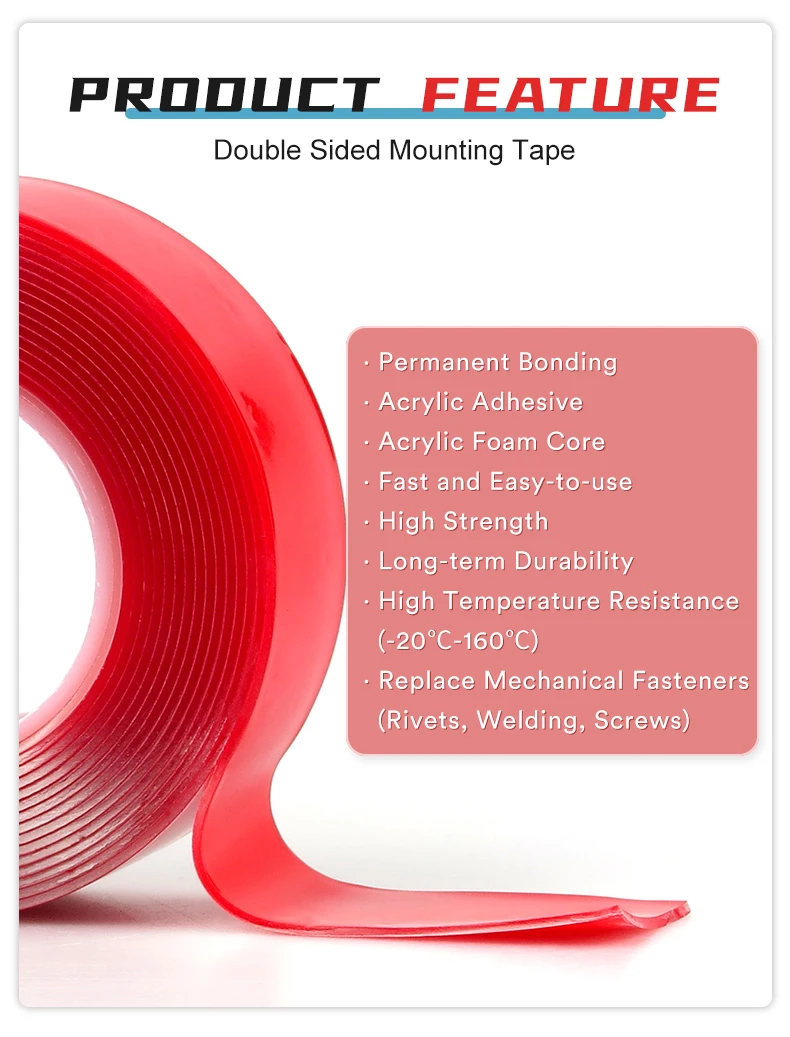
- Acrylic foam construction provides stable bonding thickness for different assembly designs.
- Acrylic adhesive delivers consistent Initial Tack and Peel Adhesion performance.
- The flexible structure helps maintain contact during vibration and thermal movement.
- Multiple thickness options allow adjustment according to component spacing requirements.
- Available adhesive grades support different substrate combinations.
- Acrylic foam bonding tape is suitable for applications requiring reliable attachment under changing operating conditions.
- Customized sizes are available for industrial applications requiring industrial strength double sided foam tape performance.
Bonding Performance Factors
Load Resistance
The final bonding result depends on the force applied to the assembled parts. Shear load, pulling force and repeated movement should be considered when selecting the appropriate tape grade.
Temperature Exposure
Changes in temperature may affect adhesive behavior and material expansion. Acrylic adhesive systems are designed to maintain stable performance within specified temperature ranges.
Material Expansion
Different substrates may expand or contract at different rates during operation. The flexible foam structure helps accommodate minor dimensional movement between bonded components.
Installation Conditions
Surface cleanliness, application pressure and contact area influence adhesive performance. Proper installation procedures help achieve consistent bonding results.
Application
Automotive Component Assembly
Used for interior modules, exterior accessories and sensor-related components where resistance to vibration and temperature variation is required.
Electronic Equipment Installation
Applied for display parts, covers, battery-related components and internal assemblies requiring accurate positioning.
Industrial Equipment Bonding
Suitable for panels, protective covers and lightweight structures exposed to continuous operation.
Lighting System Installation
Used for LED components and lighting accessories requiring stable attachment during product service.
Transportation Applications
Selected as automotive acrylic foam tape for applications requiring durability under movement, vibration and environmental exposure.
For demanding assembly conditions requiring increased holding performance, heavy duty double sided acrylic foam tape provides a reliable bonding option for industrial components.

FAQ
Q1: How does continuous loading affect acrylic foam tape performance?
Continuous load may influence adhesive deformation over time. Selecting the correct tape thickness, adhesive grade and bonding area helps maintain stable holding performance under long-term operating conditions.
Q2: Why is application pressure important when using acrylic foam tape?
Application pressure helps the adhesive contact the substrate surface more effectively. Proper pressure application improves initial bonding and supports more consistent performance after installation.
Q3: How does temperature cycling influence adhesive performance?
Repeated heating and cooling may create movement between bonded materials. Acrylic foam tape is designed to accommodate certain dimensional changes while maintaining adhesion within the specified temperature range.
Q4: What causes different bonding results between similar applications?
Differences may come from substrate materials, surface conditions, bonding area, environmental exposure and installation methods. Evaluating these factors helps determine the appropriate tape specification.
Q5: Can customers test acrylic foam tape before final application?
Yes. Sample testing is recommended before full application. Customers can evaluate adhesion performance, compatibility and installation results under actual working conditions.
Hot Tags: acrylic foam adhesive tape,Acrylic foam bonding tape,industrial strength double sided foam tape,automotive acrylic foam tape,heavy duty double sided acrylic foam tape, Die Cut Arcylic Doule Coated VHB Foam Tape, Heavy Duty Double Sided VHB Foam Tape, High Viscosity Double Sided PE Foam Tape, Super Strong Double Sided Acrylic PE Foam Tape, Very High Bond Double Sided VHB Foam Tape, Very High Bonding Double Sided PE Foam Tape


