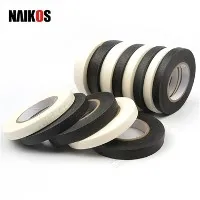
Edge lifting in graphic overlay and membrane switch assemblies occurs when internal restoring forces within stamped substrates exceed the shear resistance and peel strength of the interfacial adhesive. Utilizing a high temperature PET tape with a dimensionally stable polyester film core provides high tensile modulus and resistance to plasticizer migration, maintaining perimeter adhesion across thermal cycling from -40°C to 150°C. Preventing peripheral bond line cleavage requires matching adhesive rheology to substrate surface energy while controlling die-cutting edge compression tolerances.
Key Factors Driving Perimeter Delamination
Edge lifting typically initiates along die-cut perimeters within 24 to 72 hours post-assembly due to three primary physical vectors:
- Substrate Bending Stress: Embossed polycarbonate (PC) and aluminum overlays retain elastic memory post-stamping, exerting a continuous upward peel force along the border.
- Incomplete Surface Wet-Out: Low Surface Energy (LSE) materials like polypropylene (PP) exhibit surface energies below 36 dynes/cm, creating microscopic voids that concentrate mechanical stress along the bond line.
- Thermal Expansion Differential (CTE Mismatch): Differing expansion rates between metallic nameplates and plastic housings generate continuous shear displacement during temperature swings, causing perimeter creep.
Substrate Surface Preparation Protocols
- Solvent Degreasing: Wipe bonding interfaces with a 50:50 Isopropyl Alcohol (IPA) and deionized water mixture to eliminate residual processing oils, mold release agents, and dust.
- Surface Energy Verification: Ensure substrate dyne levels exceed 42 dynes/cm. Apply a solvent-based silane primer or plasma discharge treatment on LSE plastics below this threshold.
- Environmental Control: Maintain application temperatures between 21°C and 38°C. Bonding below 15°C restricts molecular flow and retards initial tack development.
Lamination Pressure and Converting Parameters
- Nip Roll Pressure: Apply a uniform pressure of 30 to 40 psi (200 to 275 kPa) along the bond path to force adhesive into substrate surface asperities.
- Cure Kinetics: Initial assembly yields ~50% of ultimate adhesion. Full cross-linked viscoelastic flow requires a 72-hour dwell cycle at 23°C.
- Die-Cutting Tolerances: Calibrate steel rule or rotary dies within ±0.05 mm. Dull tooling crushes perimeter backing, driving adhesive inward and leaving low-tack micro-zones along the edge.
Material Selection: Carrier and Adhesive Engineering
Non-woven tissue carriers lack axial stiffness, leading to adhesive stretch and edge tearing under mechanical shear. A double coated polyester tape utilizes a rigid PET film core (0.01 mm to 0.205 mm gauge) to resist flexural restoring forces. Cross-linked solvent acrylic formulations prevent perimeter shear creep, maintain static holding power at elevated temperatures, and resist motor oil and industrial solvents.
Implementing precise surface degreasing, controlled lamination pressure, and tight converting tolerances eliminates edge lifting in electronic and automotive assemblies. Applying double sided PET film tape guarantees high dimensional stability, heat resistance up to 150°C, and long-term interfacial bond strength across diverse industrial substrates.