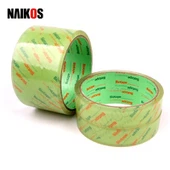
Double sided adhesive tissue tape consists of a lightweight non-woven paper carrier coated on both sides with a pressure-sensitive adhesive. Selecting the correct adhesive chemistry governs peel adhesion, temperature thresholds, and converting efficiency across industrial splicing, electronics mounting, and automotive lamination.
Solvent-Based Acrylic: High Cohesive Strength for Thermal and Chemical Extremes
Solvent acrylic systems undergo thermal cross-linking during manufacturing, creating a dense polymer network with high cohesive strength and plasticizer resistance.
- Thermal Range: Operates continuously up to 80°C.
- Adhesion & Shear: 180° peel strength to steel exceeds 14 N/25mm (≥50 oz/inch), demonstrating extended static shear holding power under 1 kg load at 80°C.
- Environmental Stability: Resists UV photo-oxidation, aliphatic solvents, fuel mists, and plasticizer migration.
- Converting: High internal cohesion limits adhesive oozing during rotary die-cutting, maintaining tolerances down to ±0.1 mm.
Specified for automotive nameplate fixation, PCB insulation lamination, and outdoor signage displays.
Hot-Melt Synthetic Rubber: Maximum Initial Tack for Fast-Paced Assembly
Hot-melt adhesives consist of thermoplastic block copolymers formulated with tackifying resins that set rapidly upon cooling without requiring solvent evaporation.
- Initial Wet-Out: Achieves immediate surface wet-out, recording a Rolling Ball Tack result of ball No. 14 or lower.
- LSE Bonding: Establishes strong initial bonds on low surface energy (LSE) materials like polypropylene (PP) and polyethylene (PE).
- Thermal Limit: Capped at 60°C (140°F); subject to shear creep under continuous load at elevated temperatures.
- Vulnerability: Degrades under prolonged exposure to organic solvents, plasticizers, and direct sunlight UV.
Optimal for high-speed indoor paper roll splicing, box sealing, and temporary positioning.
Water-Based Emulsion Acrylic: Cost-Effective Lamination for General Utility
Water-based acrylics suspend polymer beads in an aqueous medium, forming a continuous film after water evaporation in forced-air drying tunnels.
- Performance: Yields 180° peel adhesion exceeding 14 N/25mm on polar surfaces (glass, aluminum, rigid PVC) and high static shear at 23°C.
- Thermal Threshold: Maintains structural integrity up to 60°C (140°F).
- Cost Efficiency: Lowers manufacturing energy inputs, providing a balanced price-to-performance ratio for bulk bonding.
- Convertibility: Requires sharp tool geometries during slitting to prevent edge stringing on rewinding lines.
Suited for general stationery manufacturing, poster mounting, leather goods lamination, and lightweight displays.
Selection Parameters
- Temperature: Select solvent acrylic for thermal environments up to 80°C. Use hot-melt or water-based systems for ambient indoor applications.
- Substrate Energy: Low surface energy plastics (PE/PP) require the immediate tack of hot-melt rubber or modified solvent acrylics.
- Exposure: Select solvent acrylics for assemblies facing direct solar UV, solvent mists, or plasticizers.
- Converting: Precision die-cut parts demand the firm cohesive structure of non woven double sided tape to prevent tool gumming.
Direct source manufacturing controls coat weight precision and carrier fiber density to ensure consistent performance across every roll of double sided tissue tape.